


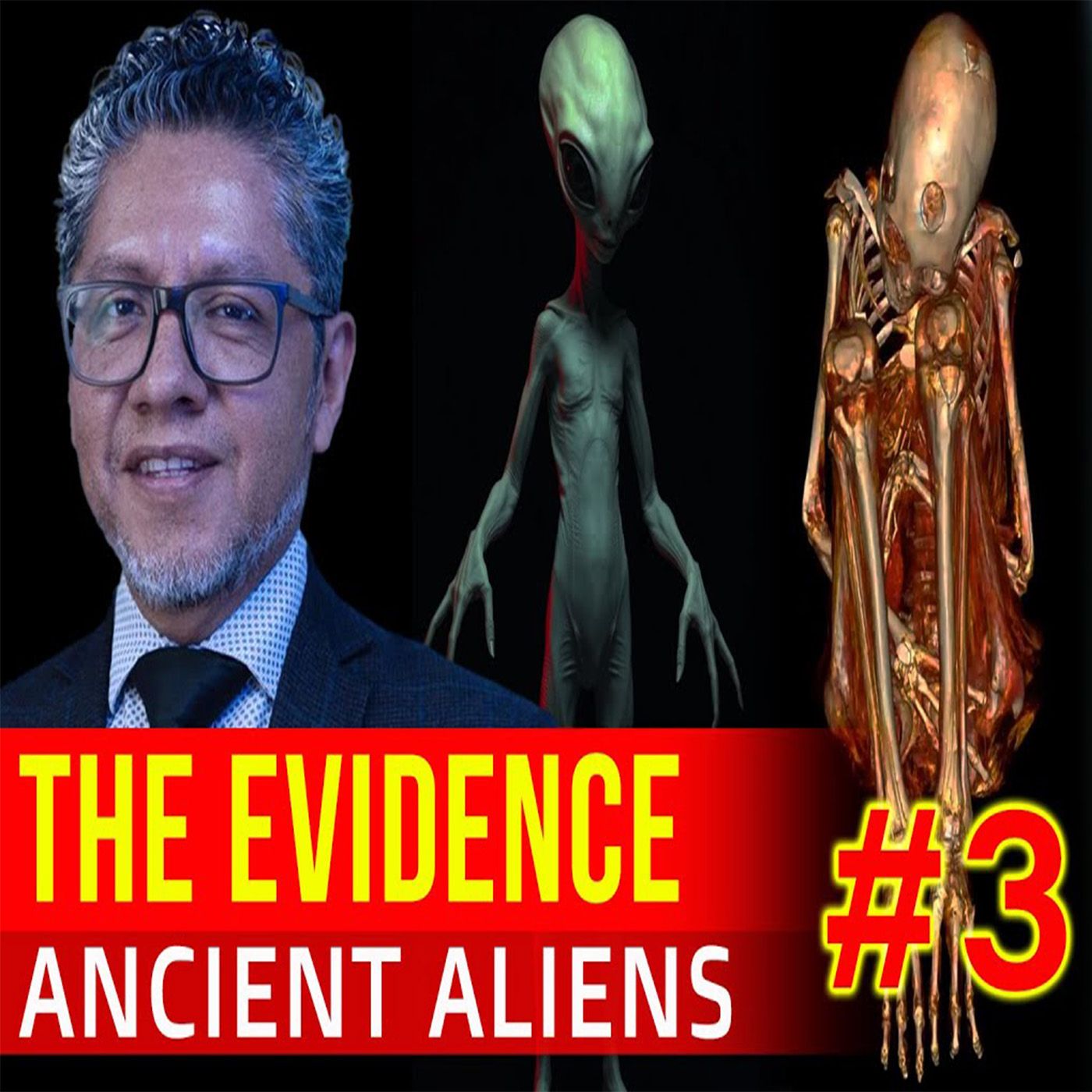
In this groundbreaking third interview with Mexican biologist Dr. Ricardo Rangel Martinez, I explore fascinating insights about ancient aliens and the mysterious Tridactyl bodies and Nazca mummies through rigorous scientific method and an extensive research study. Our research scientist presents compelling DNA analysis that challenges conventional understanding of these specimens, while archaeology evidence reveals unprecedented details about their physical characteristics.
This is Part 3 of a 4 part series. The Tridactyl Bodies have been rigorously tested and scientifically analyzed. There is a lot of data indicating they are not humans. I wanted answers, so I interviewed the scientists and legal authorities involved. This is Part 2 of a 4 part series.
To see the VIDEO of this episode, click or copy link - http://youtu.be/XeMlqpuMrEI
Visit my website with International UFO News, Articles, Videos, and Podcast direct links -www.ufonews.co
❤️ EXCLUSIVE FREE MERCH INCLUDED & BEHIND-THE-SCENES ONLY FOR MY SUPPORTERS ON PATREON ➔ https://www.patreon.com/paradigm_shifts/membership
Become a supporter of this podcast: https://www.spreaker.com/podcast/ufo-news-with-cristina-gomez--5235662/support.
Show Notes
In this groundbreaking third interview with Mexican biologist Dr. Ricardo Rangel Martinez, I explore fascinating insights about ancient aliens and the mysterious Tridactyl bodies and Nazca mummies through rigorous scientific method and an extensive research study. Our research scientist presents compelling DNA analysis that challenges conventional understanding of these specimens, while archaeology evidence reveals unprecedented details about their physical characteristics.This is Part 3 of a 4 part series. The Tridactyl Bodies have been rigorously tested and scientifically analyzed. There is a lot of data indicating they are not humans. I wanted answers, so I interviewed the scientists and legal authorities involved. This is Part 2 of a 4 part series.
To see the VIDEO of this episode, click or copy link - http://youtu.be/XeMlqpuMrEI
Visit my website with International UFO News, Articles, Videos, and Podcast direct links -www.ufonews.co
❤️ EXCLUSIVE FREE MERCH INCLUDED & BEHIND-THE-SCENES ONLY FOR MY SUPPORTERS ON PATREON ➔ https://www.patreon.com/paradigm_shifts/membership
Become a supporter of this podcast: https://www.spreaker.com/podcast/strange-and-unexplained--5235662/support.
Show Transcript
This is part three of a four part series. These episodes consist of interviewing those involved in the research of the Nasca bodies. This has never been done for an English audience before, where they go into detail on their research and their background. While the first interview is in English, the remainding three are in Spanish, with accurate English subtitles embedded in the video.
If you would like to find the English dubbed version, you can do so on my podcast at Strange and Unexplained. That link is in the description box below. Brigattado, thank you so much for being here with us today. Before we get into your research on these Nasca bodies, can you tell us a little bit about your background and how you got interested in being a part of the team for researching these bodies.
I am my biologist, graduated from the National School of Biological Sciences of the National Polytechnic Institute. I had the fortune to specialize in a very beautiful area of science, that is the imminogenetics regenitive medicine cell therapy. I currently have a company, a company dedicated especially to the study and development of new therapies related to the use of messenchinal stem cells and exomes for therapeutic use in patients with chronic degenerative and autoimmune pathologies. It's been seven years since Heimen Mauson invited me to participate in the analysis of the DNA of the tridactyl mummies, and for me, it has been an experience that has broken many paradigms from my foundations and from my knowledge as a biologist.
I've had the fortune to also participate with other research groups in the area of what could be the most important thing, the study of mammals. I spent a long time working with my wife in the study of some migratory bats that come from the United States to Mexico in the million. It's something impressive the migration that those bats make. And while this also got me very involved in the ecological aspects and the understanding of many aspects related to ecology from an evolutionary biological point of view, that changes a lot the way you interpret things.
But here's the problem we had to be able to interpret these molecules that were isolated from the NASCA mummies is precisely how to be able to carry out an adequate interpretation of that data, Because at the end of the day, that data has hundreds and thousands of pieces of information, and it was necessary to give them a logical way to be able to carry out a reading, a rigorous scientific method to be able to validate. First of all, I know that an adequate sample has been taken, that an adequate extraction of the DNA has been done to determined that this DNA really comes from an old, ancient tissue a mummy. And once this is done, you can see the feasibility of being able to interpret the data sequence of these ancient tissues. And all those processes have been passed with a check mark.
They have been given to go ahead in the sense that not only me, there is another investigator of which has also given her identity, which is Helena hard from Canada, and she has accessed the public database NHI and where they have found these tridactyl mummies. And fortunately she has also coincided that this DNA is ancient DNA, DNA with sufficient quality to be able to carry out the genetic study. And she has also been able to make a very interesting interpretation regarding the haplogroup of the mitochondrial DNA of the mummy Maria and of the hapla group of the Y chromosome. This one came to give us a surprise in a sense that well, Maria is not really Maria, she's Mario because she has a Y chromosome.
This is only present in males. And the HAPLA group of the mitochondrial DNA that is only inherited from the mother comes from a region from manmar This HAPLA group is only found in that area of the world, nowhere else, so that has been very interesting. But apart from that, I've been able to discover that in the DNA, for example of Maria or Mario. Now there also exists DNA from other organisms from Africa, such as the bonobo and the pantacid and the paniscus.
It is the chimpanzee in the bonobo which has led me to suggest the idea that this organism is really a hybrid between a species related to the genus and an organism related to the genus Homo sapiens. This obviously has to be supported genetically. New study has been done a new sample of Maria, a new study to be able to ratify it, because the structural anatomical studies are also dictating it to us, this organism is a hybrid and obviously the context in which Maria or Mario was found, which is a tridactal being in the Nasca desert. Evidently, it has raised many doubts regarding how the hybrid could have been generated.
If the organisms were brought from the region of China, if the organism was brought from the region of Africa to America and the hybridization process was carried out and it generated this organism. But in my reas since study the latest study, I found something that gives me the key to think that Maria could have been conceived naturally in Africa and was later transferred to America. We found that Maria was infected by a tripanisome that only exists in Africa. Tripanisome is transferred by the fly that Tetse, the famous Tetse fly, and it infected Maria.
So when the DNA that we managed to isolate from the bone of Maria's hand, we found reading sequences of this organism and is only found in Africa. There is no other way that she could have acquired this parasite because the vector that transmits this virus only lives in a very specific area of Africa, which is in the area of the Congo in the central area. This fly does not exist in either North Africa or South Africa. It only lived in this central area of the Congole.
It is a very endemic area where this fly exists. So Maria was infected by this fly. It has the parasite. We found the sequences of the parasite, and we also found other sequences of another parasite, protos, which is a pasmodium that does not exist in the Nasca area either.
So all this leads us to assume that this and this is my hypothesis, that Maria is really the product of a natural hybridization process that took place in Africa. Due to the degree of specialization regarding the adaptation of the tridactyl Maria makes me suppose that this organism was really of arboreal habits. The fact that we do not find vestiges of the existence of these two fingers, the thumb and the pinky and only these three fingers, just like the sloth bear that lives in the Amazon jungle, which also has only three fingers, And this leads me to assume that this organism, at least it has been two hundred and three hundred thousand years since this hybridization process was carried out.
And let us remember also that the latest findings regarding the data of the skeleton that was found, it seems to me and Iraq or in the area from the Middle East, they were dated with carbon fourteen and approximately they were between two hundred and three hundred thousand years old. These bones, they constitute a Homo sapien. So this makes me think that this hybridization process could have been very easily taken because from the southern part of Asia, migration to Africa is feasible. There really is a straight there where you can cross this and reach more easily to Africa.
It was this continent where it was created this hybridization and in a very natural way. Doctor Eugene McCarthy is I think the most important scientific representative of the process of natural hybridization that exists in the world. He has many scientific works in relation to the evolutionary process that had to happen to complete the hybridization process for the generation of new species. So I am just in the process of being able to contact doctor Eugene McCarthy to be able to allocate what the early process which this natural hybridization was achieved, which is my current hypothesis.
I think that Maria and this is the this is not the product of a non natural hybridization process of genetic engineering, but rather it was truly a natural process that has at least two hundred to three hundreds years of evolution in a generational chronological timeline, it is too little time to evolve. Then it is very likely at this entire population has been captured of at least these ten or eleven organisms that we have or that have been documented to exist at least between ten and eleven organisms similar to Maria, not like the little ones of the sixty centimeters. These organisms like Maria or Mario, these among them, this one we have to do the DNA analysis and carbon fourteen deposition to be able to see if they really constitute a family or a nucleus that was captured and transmitted to America.
And in addition, the other finding that I'm finding very important is that at least in five or six of these organisms we have a a genetic malformation called pectus exa vectum. The chest is found sunken inwards. It is a deformation of the external and the vertebrae that are inwards. So this in human beings can occur, but in very low frequencies, that is to say, maybe one a million, one in five million.
It's a very strange malformation. So the fact that in ten organisms five or six present this deformation, this tells me that possibly in this nucleus there was already inbreeding, that is to say, that they were reproducing between relatives, between children and cousins and so on. This deformation was being expressed with this great frequency, and possibly there was already a very strong process of isolation in this population of these organisms, which has generated precisely this situation of inbreeding and these malformations in their bodies. This is the tip of the iceberg.
We have a lot of genetic information. I keep finding new things, and I'm already organizing to be able to write a paper. We are already writing the scientific paper together with the scientists from the University of Eca, and we're going to make this information known precisely and in scientific language, so that obviously all of this is given the seriousness that the case carries. Obviously there are other things that we cannot understand, especially the implants I believe and I am convinced that the implants that have been in these mummies were already placed once they arrived to the Americas, and they underwent a process of reaching a completely different ecological niche, and that obviously that that put her Maria put her life at risk.
Also, among the things that we have found in Maria's genome the case of Maria's death, which was possibly bacterial sepsis caused by the hemolytic vibro A bacteria. And this bacteria was found in a very high concentration in the genome of Maria's bones, because this tells us that she experienced a sepsis, a septocemia, an entry of the bacteria into the bloodstream that was spreading. And let me tell you that someone within the Eca group found something that was recently published in the Brazilian journal and they found signs of folci where there was a steolysis's saying that the bone was infected. So this supports the discovery of the bacteria, of the genome of the bacteria.
Let me also tell you that the recent analysis done by the Culture Committee of Peru did they took Maria to have some tomography studies done and also X rays and they found and then the report that the doctors from the Ministry of Culture of Peru found some lines called Harris lines. Those Harris lines are evidence that Maria had a chronic infection. So this chronic infection is explained precisely by the infection she had, perhaps since she was young in Africa, with the tetsef libe and the tripanisome. And this tripanosome generally does not cause death, but it does cause a chronic infection, and this infection easily explains the discovery by the Ministry of Culture that is made when finding the Harris lines in the bones.
The DNA analysis currently, it's also something very notorious that we must emphasize is that practically the DNA could be extracted from both the tiny beings of the sixty centimeters and from Maria is of really an extraordinary quality, which also makes us think that the desiccation process that the NAZCA bodies underwent with diatomaceous earth and other elements allowed the DNA to be preserved very very well. Let me also tell you that I have been reviewing reading sequences of recent experiments by several institutions in the United States and Europe that have been uploaded precisely to NIH, to BLAST and all these international DNA databases, even gen Book, and I'm surprised to see, for example, that they extracted DNA and obtained I don't know, fifty million readings, others over seventy million, another ten million.
In this DNA, we obtained more than six hundred million reading sequences. That is an extraordinary large amount. That is with a few contemporary experiments with fresh DNA from living cells. The DNA has just been extracted.
It has not been possible to obtain the DNA after this process of massive sequencing of what has been found and what has been obtained with these samples of the tridactyl mummies, it is really something surprising. As for difficulties, well, there have been really no difficulties because the process has been appropriately done. Many people have said that there has not been a chain of custody, so we doubt the integrity of the originality of the DNA. And what I can tell you is that this chain process is not a mysterious process that you have to go into a highly sterile situation where the world must be dressed up as an astronaut at the time of taking the samples to be able to take them to the laboratory.
Much of that is science fiction, and they have tried to sell us that. In reality, it is not that exaggerated in the sense because once those who have taken the samples, which you can confirm in various documents, including on the History Channel, when Maria's samples were taken, there was a doctor and there were several people, and they put on face masks, they put on their sterile gloves and all that fun stuff, and they were obviously in a place that wasn't a laboratory, but they were in an isolated place without drafts. They immediately put the tissue into the steril bottle and closed it, and once that bottle is closed, it's not open again until it is found in the laminar flow hood, where it is a sterile environment to be able to obtain tissue and extract the DNA.
So that's incredible, But we don't have to exaggerate the chain of custody because each custody is done once it arrives at the laboratory and the process of DNA extraction begins. There are already very well defined protocols to prevent contamination at the time of manipulation, when the vial is opened and the tissue is extracted. This is something very important. And on the other hand, the tissue, because it is a discovery that was found in a case, obviously it will have contaminations.
There will be contaminants from the organism that inhabited the cave. There's also perhaps from the person who stole the specimen, maybe someone that sneezed on it through a flu virus at it, which we actually have that information. Yes, there is a modern flu virus in the sequencing of Maria and obviously many people have been in contact with him and surely manipulated it without the appropriate precautions, and obviously there is going to be this type of contamination, but it is natural. That is any archaeological piece that is taken out an archaeologist with all the care in the world, he will also see there is a moment in which he'll find as he's in the open hair, maybe a spore of a fungus can also reach there, something like a respiratory draw uple it from a boy who had just needed That's how it could have gotten there.
It's possible that of finding that is not contaminated. What's more, if it's not contaminated at all, I would doubt the originality of the sample. I would have doubts. So all of this has been resolved in an very important way and without any doubt.
And here it is obviously a first experience. And what is being invited is that all interested scientific peer specialist in a genetic analysis of bioinformation who are interested in carrying out a new study, the doors of the university are open for them to travel. They can take the samples, they can transfer them their laboratories, and they can carry out the study of DNA extraction from massive sequencing and its subsequent bioinformation analysis. That's what we're doing, and I think that every time we're finding more important evidence of what these organisms are.
I am completely sure that is a new species of hominid, this one that arose through a hybridization process at least two hundred to three hundred years ago. This breach of the hominid branched from chimpanzees and humans and moved into an arboreal habitat because of these tridactal adaptations that allowed them to live perfectly in an arboreal environment in a tree, eating fruits, eating this and that and other types of food from the trees. These adaptations allowed it to be able to move perfectly. Its center of gravity is also very important and is in accordance with an organism that inhabits the trees and the foliage.
We are also observed with the mummy's feet and hands, and we are doing a comprehensive study precisely on those characteristics, and we're going to make all of this known in the publication that we're working on. We hope in the next year, maybe by February or so, the paper will be ready and you can contact me at XOME seventy one, that is EXOSOM seventy one at gmail dot com. At this moment, in fact, we are already building an official online website where we're going to advertise all of the tomography scans, all the X rays, all the genetics studies that we've carried out. And this is the page that is nonprofit where we're going to invite any scientist who wants to access it.
It can be registered that we have to give you an access code and you can download DMRIS, the x rays, the DNA studies, the interpretations and with the obvious purpose of being able to have control of the people who are interested in the subject, and that they can collaborate in the discovery, in the interpretation, and obviously in the new studies that are going to be carried out. So this is also going to be published very soon, and I think hopefully it'll be out in February and maybe March of twenty twenty five, and that'll be ready. We also hope that this is also a means by which well that many people have complained and they don't have access to the high resolution tomography scans, and that is true.
Whoever is interested, you will be able to access these demography scans so that you can study them and see that these are really organisms that at some point they had life, and there is no trace that they have been manipulated. On the contrary, they have neo formation, which are very interesting new structures that they are worthy of the scientific community to look at. Christina, thank you so much for having me on. If you would like to watch the original interview in Spanish with English subtitles, you can do so on my YouTube under Christina Gomez.
There is no h in Christina. If you enjoyed this podcast, make sure to give it a follow and comment what your favorite part was right down below if you're listening to this on Spotify. That is it for today. I will see you next time.
Be safe and remember keep your eyes on the sky's
Listen On


Also Listen
-

Jake Barber Joins Congress With a New UAP Evidence Plan
Cristina Gomez reviews the latest UFO / UAP news and covers Jake Barber’s new jo -
Stephen Miller, Trump and the Next UFO Disclosure Move
Cristina Gomez reviews the latest UFO / UAP news and covers a claim from journal -
The SECRET Report On CRASHED UFO In Canada
Cristina Gomez reviews the latest UFO / UAP news and covers veteran Canadian UFO -
UFO Pilots Are AI From the Future
Cristina Gomez reviews the latest UFO / UAP news and covers retired Army intelli
Transcript
This is part three of a four part series. These episodes consist of interviewing those involved in the research of the Nasca bodies. This has never been done for an English audience before, where they go into detail on their research and their background. While the first interview is in English, the remainding three are in Spanish, with accurate English subtitles embedded in the video.
If you would like to find the English dubbed version, you can do so on my podcast at Strange and Unexplained. That link is in the description box below. Brigattado, thank you so much for being here with us today. Before we get into your research on these Nasca bodies, can you tell us a little bit about your background and how you got interested in being a part of the team for researching these bodies.
I am my biologist, graduated from the National School of Biological Sciences of the National Polytechnic Institute. I had the fortune to specialize in a very beautiful area of science, that is the imminogenetics regenitive medicine cell therapy. I currently have a company, a company dedicated especially to the study and development of new therapies related to the use of messenchinal stem cells and exomes for therapeutic use in patients with chronic degenerative and autoimmune pathologies. It's been seven years since Heimen Mauson invited me to participate in the analysis of the DNA of the tridactyl mummies, and for me, it has been an experience that has broken many paradigms from my foundations and from my knowledge as a biologist.
I've had the fortune to also participate with other research groups in the area of what could be the most important thing, the study of mammals. I spent a long time working with my wife in the study of some migratory bats that come from the United States to Mexico in the million. It's something impressive the migration that those bats make. And while this also got me very involved in the ecological aspects and the understanding of many aspects related to ecology from an evolutionary biological point of view, that changes a lot the way you interpret things.
But here's the problem we had to be able to interpret these molecules that were isolated from the NASCA mummies is precisely how to be able to carry out an adequate interpretation of that data, Because at the end of the day, that data has hundreds and thousands of pieces of information, and it was necessary to give them a logical way to be able to carry out a reading, a rigorous scientific method to be able to validate. First of all, I know that an adequate sample has been taken, that an adequate extraction of the DNA has been done to determined that this DNA really comes from an old, ancient tissue a mummy. And once this is done, you can see the feasibility of being able to interpret the data sequence of these ancient tissues. And all those processes have been passed with a check mark.
They have been given to go ahead in the sense that not only me, there is another investigator of which has also given her identity, which is Helena hard from Canada, and she has accessed the public database NHI and where they have found these tridactyl mummies. And fortunately she has also coincided that this DNA is ancient DNA, DNA with sufficient quality to be able to carry out the genetic study. And she has also been able to make a very interesting interpretation regarding the haplogroup of the mitochondrial DNA of the mummy Maria and of the hapla group of the Y chromosome. This one came to give us a surprise in a sense that well, Maria is not really Maria, she's Mario because she has a Y chromosome.
This is only present in males. And the HAPLA group of the mitochondrial DNA that is only inherited from the mother comes from a region from manmar This HAPLA group is only found in that area of the world, nowhere else, so that has been very interesting. But apart from that, I've been able to discover that in the DNA, for example of Maria or Mario. Now there also exists DNA from other organisms from Africa, such as the bonobo and the pantacid and the paniscus.
It is the chimpanzee in the bonobo which has led me to suggest the idea that this organism is really a hybrid between a species related to the genus and an organism related to the genus Homo sapiens. This obviously has to be supported genetically. New study has been done a new sample of Maria, a new study to be able to ratify it, because the structural anatomical studies are also dictating it to us, this organism is a hybrid and obviously the context in which Maria or Mario was found, which is a tridactal being in the Nasca desert. Evidently, it has raised many doubts regarding how the hybrid could have been generated.
If the organisms were brought from the region of China, if the organism was brought from the region of Africa to America and the hybridization process was carried out and it generated this organism. But in my reas since study the latest study, I found something that gives me the key to think that Maria could have been conceived naturally in Africa and was later transferred to America. We found that Maria was infected by a tripanisome that only exists in Africa. Tripanisome is transferred by the fly that Tetse, the famous Tetse fly, and it infected Maria.
So when the DNA that we managed to isolate from the bone of Maria's hand, we found reading sequences of this organism and is only found in Africa. There is no other way that she could have acquired this parasite because the vector that transmits this virus only lives in a very specific area of Africa, which is in the area of the Congo in the central area. This fly does not exist in either North Africa or South Africa. It only lived in this central area of the Congole.
It is a very endemic area where this fly exists. So Maria was infected by this fly. It has the parasite. We found the sequences of the parasite, and we also found other sequences of another parasite, protos, which is a pasmodium that does not exist in the Nasca area either.
So all this leads us to assume that this and this is my hypothesis, that Maria is really the product of a natural hybridization process that took place in Africa. Due to the degree of specialization regarding the adaptation of the tridactyl Maria makes me suppose that this organism was really of arboreal habits. The fact that we do not find vestiges of the existence of these two fingers, the thumb and the pinky and only these three fingers, just like the sloth bear that lives in the Amazon jungle, which also has only three fingers, And this leads me to assume that this organism, at least it has been two hundred and three hundred thousand years since this hybridization process was carried out. And let us remember also that the latest findings regarding the data of the skeleton that was found, it seems to me and Iraq or in the area from the Middle East, they were dated with carbon fourteen and approximately they were between two hundred and three hundred thousand years old.
These bones, they constitute a Homo sapien. So this makes me think that this hybridization process could have been very easily taken because from the southern part of Asia, migration to Africa is feasible. There really is a straight there where you can cross this and reach more easily to Africa. It was this continent where it was created this hybridization and in a very natural way.
Doctor Eugene McCarthy is I think the most important scientific representative of the process of natural hybridization that exists in the world. He has many scientific works in relation to the evolutionary process that had to happen to complete the hybridization process for the generation of new species. So I am just in the process of being able to contact doctor Eugene McCarthy to be able to allocate what the early process which this natural hybridization was achieved, which is my current hypothesis. I think that Maria and this is the this is not the product of a non natural hybridization process of genetic engineering, but rather it was truly a natural process that has at least two hundred to three hundreds years of evolution in a generational chronological timeline, it is too little time to evolve.
Then it is very likely at this entire population has been captured of at least these ten or eleven organisms that we have or that have been documented to exist at least between ten and eleven organisms similar to Maria, not like the little ones of the sixty centimeters. These organisms like Maria or Mario, these among them, this one we have to do the DNA analysis and carbon fourteen deposition to be able to see if they really constitute a family or a nucleus that was captured and transmitted to America. And in addition, the other finding that I'm finding very important is that at least in five or six of these organisms we have a a genetic malformation called pectus exa vectum. The chest is found sunken inwards.
It is a deformation of the external and the vertebrae that are inwards. So this in human beings can occur, but in very low frequencies, that is to say, maybe one a million, one in five million. It's a very strange malformation. So the fact that in ten organisms five or six present this deformation, this tells me that possibly in this nucleus there was already inbreeding, that is to say, that they were reproducing between relatives, between children and cousins and so on.
This deformation was being expressed with this great frequency, and possibly there was already a very strong process of isolation in this population of these organisms, which has generated precisely this situation of inbreeding and these malformations in their bodies. This is the tip of the iceberg. We have a lot of genetic information. I keep finding new things, and I'm already organizing to be able to write a paper.
We are already writing the scientific paper together with the scientists from the University of Eca, and we're going to make this information known precisely and in scientific language, so that obviously all of this is given the seriousness that the case carries. Obviously there are other things that we cannot understand, especially the implants I believe and I am convinced that the implants that have been in these mummies were already placed once they arrived to the Americas, and they underwent a process of reaching a completely different ecological niche, and that obviously that that put her Maria put her life at risk. Also, among the things that we have found in Maria's genome the case of Maria's death, which was possibly bacterial sepsis caused by the hemolytic vibro A bacteria. And this bacteria was found in a very high concentration in the genome of Maria's bones, because this tells us that she experienced a sepsis, a septocemia, an entry of the bacteria into the bloodstream that was spreading.
And let me tell you that someone within the Eca group found something that was recently published in the Brazilian journal and they found signs of folci where there was a steolysis's saying that the bone was infected. So this supports the discovery of the bacteria, of the genome of the bacteria. Let me also tell you that the recent analysis done by the Culture Committee of Peru did they took Maria to have some tomography studies done and also X rays and they found and then the report that the doctors from the Ministry of Culture of Peru found some lines called Harris lines. Those Harris lines are evidence that Maria had a chronic infection.
So this chronic infection is explained precisely by the infection she had, perhaps since she was young in Africa, with the tetsef libe and the tripanisome. And this tripanosome generally does not cause death, but it does cause a chronic infection, and this infection easily explains the discovery by the Ministry of Culture that is made when finding the Harris lines in the bones. The DNA analysis currently, it's also something very notorious that we must emphasize is that practically the DNA could be extracted from both the tiny beings of the sixty centimeters and from Maria is of really an extraordinary quality, which also makes us think that the desiccation process that the NAZCA bodies underwent with diatomaceous earth and other elements allowed the DNA to be preserved very very well. Let me also tell you that I have been reviewing reading sequences of recent experiments by several institutions in the United States and Europe that have been uploaded precisely to NIH, to BLAST and all these international DNA databases, even gen Book, and I'm surprised to see, for example, that they extracted DNA and obtained I don't know, fifty million readings, others over seventy million, another ten million.
In this DNA, we obtained more than six hundred million reading sequences. That is an extraordinary large amount. That is with a few contemporary experiments with fresh DNA from living cells. The DNA has just been extracted.
It has not been possible to obtain the DNA after this process of massive sequencing of what has been found and what has been obtained with these samples of the tridactyl mummies, it is really something surprising. As for difficulties, well, there have been really no difficulties because the process has been appropriately done. Many people have said that there has not been a chain of custody, so we doubt the integrity of the originality of the DNA. And what I can tell you is that this chain process is not a mysterious process that you have to go into a highly sterile situation where the world must be dressed up as an astronaut at the time of taking the samples to be able to take them to the laboratory.
Much of that is science fiction, and they have tried to sell us that. In reality, it is not that exaggerated in the sense because once those who have taken the samples, which you can confirm in various documents, including on the History Channel, when Maria's samples were taken, there was a doctor and there were several people, and they put on face masks, they put on their sterile gloves and all that fun stuff, and they were obviously in a place that wasn't a laboratory, but they were in an isolated place without drafts. They immediately put the tissue into the steril bottle and closed it, and once that bottle is closed, it's not open again until it is found in the laminar flow hood, where it is a sterile environment to be able to obtain tissue and extract the DNA. So that's incredible, But we don't have to exaggerate the chain of custody because each custody is done once it arrives at the laboratory and the process of DNA extraction begins.
There are already very well defined protocols to prevent contamination at the time of manipulation, when the vial is opened and the tissue is extracted. This is something very important. And on the other hand, the tissue, because it is a discovery that was found in a case, obviously it will have contaminations. There will be contaminants from the organism that inhabited the cave.
There's also perhaps from the person who stole the specimen, maybe someone that sneezed on it through a flu virus at it, which we actually have that information. Yes, there is a modern flu virus in the sequencing of Maria and obviously many people have been in contact with him and surely manipulated it without the appropriate precautions, and obviously there is going to be this type of contamination, but it is natural. That is any archaeological piece that is taken out an archaeologist with all the care in the world, he will also see there is a moment in which he'll find as he's in the open hair, maybe a spore of a fungus can also reach there, something like a respiratory draw uple it from a boy who had just needed That's how it could have gotten there. It's possible that of finding that is not contaminated.
What's more, if it's not contaminated at all, I would doubt the originality of the sample. I would have doubts. So all of this has been resolved in an very important way and without any doubt. And here it is obviously a first experience.
And what is being invited is that all interested scientific peer specialist in a genetic analysis of bioinformation who are interested in carrying out a new study, the doors of the university are open for them to travel. They can take the samples, they can transfer them their laboratories, and they can carry out the study of DNA extraction from massive sequencing and its subsequent bioinformation analysis. That's what we're doing, and I think that every time we're finding more important evidence of what these organisms are. I am completely sure that is a new species of hominid, this one that arose through a hybridization process at least two hundred to three hundred years ago.
This breach of the hominid branched from chimpanzees and humans and moved into an arboreal habitat because of these tridactal adaptations that allowed them to live perfectly in an arboreal environment in a tree, eating fruits, eating this and that and other types of food from the trees. These adaptations allowed it to be able to move perfectly. Its center of gravity is also very important and is in accordance with an organism that inhabits the trees and the foliage. We are also observed with the mummy's feet and hands, and we are doing a comprehensive study precisely on those characteristics, and we're going to make all of this known in the publication that we're working on.
We hope in the next year, maybe by February or so, the paper will be ready and you can contact me at XOME seventy one, that is EXOSOM seventy one at gmail dot com. At this moment, in fact, we are already building an official online website where we're going to advertise all of the tomography scans, all the X rays, all the genetics studies that we've carried out. And this is the page that is nonprofit where we're going to invite any scientist who wants to access it. It can be registered that we have to give you an access code and you can download DMRIS, the x rays, the DNA studies, the interpretations and with the obvious purpose of being able to have control of the people who are interested in the subject, and that they can collaborate in the discovery, in the interpretation, and obviously in the new studies that are going to be carried out.
So this is also going to be published very soon, and I think hopefully it'll be out in February and maybe March of twenty twenty five, and that'll be ready. We also hope that this is also a means by which well that many people have complained and they don't have access to the high resolution tomography scans, and that is true. Whoever is interested, you will be able to access these demography scans so that you can study them and see that these are really organisms that at some point they had life, and there is no trace that they have been manipulated. On the contrary, they have neo formation, which are very interesting new structures that they are worthy of the scientific community to look at.
Christina, thank you so much for having me on. If you would like to watch the original interview in Spanish with English subtitles, you can do so on my YouTube under Christina Gomez. There is no h in Christina. If you enjoyed this podcast, make sure to give it a follow and comment what your favorite part was right down below if you're listening to this on Spotify.
That is it for today. I will see you next time. Be safe and remember keep your eyes on the sky's
Comments & Upvotes